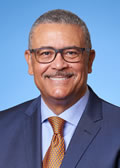
NAMI Names New CEO: Daniel H. Gillison Jr.,Takes Reins Of Largest Grassroots Mental Health Org.

(12-18-19) Daniel H. Gillison Jr., has been named Chief Executive Officer of the  National Alliance on Mental Illness, the nation’s largest and wealthiest grassroots mental health organization.

His selection was announced today at 2 p.m., shortly after the national staff was informed.

He takes the reins from Angela Kimball, who became acting CEO after the abrupt resignation of previous CEO Mary Gilliberti in April. Kimball was widely credited by NAMI insiders for keeping up morale in the national office located in Arlington, Va., after Giliberti was asked by the board to resign. Kimball had been a candidate for the CEO job.

For the past three years, Gillison has directed the American Psychiatric Association’s Foundation, the philanthropic and public education arm of the APA.  He is NAMI’s first African American CEO.

Before he joined the APA, Gillison worked for the National Association of Counties (NACo) where he led corporate and philanthropic fundraising efforts and directed the educational programming of the NACo Research Foundation. During Gillison’s time at NACo, corporate support more than doubled and the NACo Foundation substantially expanded its educational offerings in mental health and criminal justice. He has previously held positions at Sprint, XO Communications, and Wesley Brown & Bartle.

The NAMI board has a history of micro-managing the national office, which will test GIllison’s leadership abilities. As I reported Monday, NAMI became the nation’s dominant mental health player during Giliberti’s five year tenure, raising $17.6 million in revenues last year, according to its most recent Form 990 filings. It reported net assets or fund balances of $15 million.  Giliberti was paid $202,095 in salary and received $39,583 in additional financial benefits. We’ll have to wait for the next Form 990 reporting to learn what Gillison is being paid.

While at NACo, Gillison supported the national Stepping Up Initiative, created to divert individuals with mental illnesses from jails and prisons into community treatment, which is a promising sign. Sadly, the American Psychiatric Association has been pusillanimous when it comes to focusing on the serious mentally ill.


Yearly Revenues and CEO Salaries For Mental Health Groups: NAMI Largest Grassroots: $17.6 million

(12-16-19) All of us receive requests at year end from mental health organizations seeking much needed charitable donations. Before writing a check, I always find it helpful to examine each charity’s IRS Form 990, which is available on the Guidestar website.

I check three numbers: the amount of revenues that were received, the amount of net assets that the organization lists at year end, and how much a nonprofit group pays its CEO. Mental health groups must be competitive so it is not surprising that most CEO salaries are in the same $200,000 range here in Washington D.C.. That is higher than the national average. CEOs who manage organizations with multimillion dollar budgets are generally better compensated.

A quick Internet check found this thumbnail guideline:

An operating budget of a nonprofit organization under $500,000 corresponded with a CEO salary of $60,206. The highest category matched an operating budget of $50,000,000 with a CEO salary of $317,024. The average nonprofit CEO makes a little more than $120,000 a year, according to the 2016 Charity CEO Compensation Study by Charity Navigator.

Of course, there is other useful information on the tax forms. Forms reported in this blog are from the latest available reports on Guidestar.

So how do mental health nonprofits compare?

Click to continue…

SMI Advocate Pushing His Agenda With White House & Democrats: AOT, HIPAA Reform, More Hospital Beds

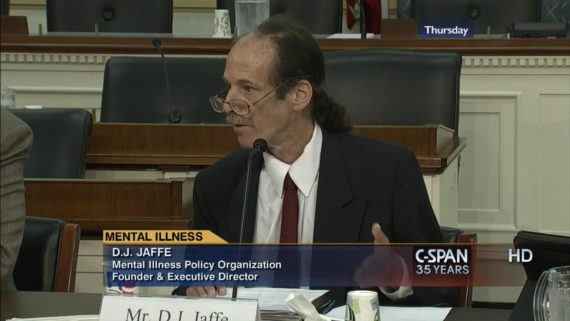
(12-13-19) Advocate and Author D. J. Jaffe is pushing an agenda with both the White House and Democrats that calls for creating more hospital beds for the seriously mentally ill, increasing the use of Assisted Outpatient Treatment, and revising HIPAA regulations that often prevent caregivers from obtaining information.

Jaffe’s fingerprints were all over Democratic presidential candidate Sen. Kamala Harris’s mental health policy, which I recently posted. After she dropped out, I learned that her staff had been in the midst of rewriting that policy because of concerns raised by the Bazelon Center for Mental Health law and others, who generally oppose Jaffe’s agenda. A compromise version was in the works but became moot once Sen. Harris ended her campaign. Yesterday, Jaffe posted an Op Ed in The Hill newspaper urging other candidates to adopt the plan that Harris originally released.

Jaffe will be presenting his ideas Dec. 19th at a White House Summit on Transforming Mental Health Treatment to Combat Homelessness, Violence & Substance Abuse. Here is part of a press release about by-invitation-only event.

DJ Jaffe, who has a seriously mentally ill family member, will make the case that due to mission-creep, the mental health system no longer focuses on the most seriously mentally and that explains why homelessness and incarceration are increasing in spite of increased spending. He will describe ideas states, and ideas localities can use to replace politically correct but ineffective programs with ones that will help improve care for the seriously ill. He will describe the need to increase use of Assisted Outpatient Treatment (AOT)increase the availability of hospital beds and free families of seriously mentally ill from the HIPAA Handcuffs that prevent them from helping mentally ill loved ones.

Click to continue…

Insurance Refused To Pay. $110,000 Bill For Son’s Out-of-Network Care. Parity An Illusion. No Care In Rural Areas

Courtesy of the National Council On Behavioral Health

(12-9-19) Terresa Humphries-Wadsworth took her 14-year old son to an emergency room in Cody, Wyoming, because he was expressing thoughts of suicide. The staff sent him to the closest hospital with a psychiatric unit.

It was a hundred miles away in Montana.

Her son spent 10 days there before Humprhries-Wadsworth learned the hospital was out-of-network for her insurance. The closest in in-network facility was 200 miles away from their home.

The family ended up with $110,000 in out-of pocket expenses for two inpatient visits and residential treatment. They negotiated the amount down with the hospital and a collections agency, then took out loans to pay it off.

The Humphries-Wadsworth’s story was recently told by Kaiser Health News writer Jenny Gold in an article about parity. She explained how Congress passed a law mandating insurers provide equal access for mental and physical health care eleven years ago, but barriers to parity continue today.

I posted a blog last week about “patient boarding” in emergency rooms. Many of you wrote on my Facebook page about long waits that you had encountered in emergency rooms. Today, I am asking readers to share their stories on Facebook about how their insurance companies failed to treat mental health emergencies the same way financially that they do with physical problems. I will share them with the Kennedy Forum and Congress.

Click to continue…

No Room In Inn: Psychiatric Patients Remain Stuck In ER’s, Sometimes Days Waiting For Beds

Imamu Baraka came to the aide of a woman discharged on Jan. 9 from a Baltimore hospital wearing only a gown and socks. Baraka recorded video of the incident. (Facebook.com/imamu.baraka)

(12-3-19) Nothing illustrates “patient dumping” better than the viral video of 22-year-old Rebecca Hall being tossed out of the University of Maryland Medical Center into the freezing cold in January 2018 wearing little more than a hospital gown.

Delayed and Deteriorating: Serious Mental Illness and Psychiatric Boarding in Emergency Departments, a recent study released by the Treatment Advocacy Center, warns that Americans who visit emergency rooms with psychiatric problems have a higher rate of being dumped or being “boarded” than those without mental illnesses.

Psychiatric boarding is defined differently but most hospital administrators say having to wait six hours or more after being diagnosed in an emergency room awaiting treatment constitutes “boarding.” A 2016 survey by the American College of Emergency Physicians, found that more than 90% of emergency physicians say psychiatric patients board in their emergency room.

The average emergency room wait in Georgia for psychiatric patients requiring an inpatient bed is a whopping 34 hours, according to the TAC study authored by Elizabeth Sinclair Hancq, Jessica Walthall and John Snook.  Psychiatric patients who required admission to a hospital or transfer to a bed in a psychiatric facility in Massachusetts waited in emergency rooms from 16.5 to 21.5 hours compared to 3.9 hours to 4.2 hours for medical or surgical patients needing beds.

Click to continue…

Harris Releases “Everything We’ve Been Looking For” Mental Health Plan, Advocate Says. White House Planning December Summit To Discuss Its Agenda

official campaign photo

(11-29-19) The White House will be hosting a summit on Transforming Mental Health Treatment to Combat Homelessness, Violence and Substance Abuse on December 19th.  I will be attending and will report about the Trump Administration’s plan.

Several 2020 presidential candidates are releasing proposals about mental health care. Democratic Senator Kamala Harris (Ca.) posted her goals this week.

D. J. Jaffe, who frequently testifies before Congress and critiques federal policy and agencies in his book, Insane Consequences: How The Mental Health Industry Fails The Mentally Ill, reacted with this email comment:

“Wow! Kamala Harris announces Mental Health Plan with everything we’ve been looking for to help seriously mentally ill: Parity, End IMD Exclusion, more hospital beds, Fund AOT, Fix HIPAA, Focus research on SMI, end solitary, increase workforce, Reclassify schiz, fund clubhouses CIT housing & more! I don’t endorse specific candidates but I sure endorse this plan!”

If you know of another candidate’s plan that you like, please let me know on Facebook.  You can react to Candidate Kamala Harris’ plan by commenting on Facebook or Twitter. I’m told both accounts are monitored by her campaign staff.

KAMALA’S PLAN TO ADDRESS THE MENTAL HEALTH CARE CRISIS AND PROVIDE MENTAL HEALTH CARE ON DEMAND | FULL POLICY

Our country is in a mental health care crisis. Over 45 million adults—nearly 20% of all U.S. adults—experienced mental illness in 2017Suicide is on the rise, increasing 30% or higher in 25 states from 1999 to 2016. As natural catastrophes and man-made traumatic events like shootings devastate our communities, post-traumatic reactions in children and adults follow.

Yet even as nearly 60% of Americans seek mental health services for themselves or loved ones, more than half of the adults with mental illness—nearly 27 million—did not receive treatment in 2017.

In 2020, mental health care justice is on the ballot.

We need to act. As president, Kamala will make sure we deliver mental health on demand—that is, she will provide services to all Americans who need it, whenever they need it, and wherever they need it.

  • She’ll cover mental health on demand via telemedicine through her Medicare for All plan, providing direct access to mental health care professionals—with no deductibles and no copays.
  • She’ll double the number of treatment beds nationwide, prioritizing states with shortages including Iowa, Nevada, South Carolina, and Michigan, so persons with mental illness can receive the high levels of care they need.
  • As we improve mental health services across the country, she’ll make sure we meet the unique needs of vulnerable populations, including our veterans and our children. For example, she’ll double DoD and VA research dollars to address and treat PTSD, military sexual trauma, and traumatic brain injury.
  • And Kamala knows that children’s earliest life experiences, from poverty to exposure to violence and other trauma, have profound effects on their brain development and long-term health and safety, and that early intervention is key to ensuring that every child has the opportunity to develop to their full potential and become resilient when traumatic events strike. That’s why she’ll fight for evidence-based screenings for childhood trauma to diagnose and treat mental illness as early as possible.
HERE’S HOW SHE’LL DO IT:

Click to continue…